Micro-Rituals for Everyday Presence
You do not need an hour of meditation. You need thirty seconds and one thing you already do every day.
You do not need to meditate for an hour. You do not need a retreat, a journal with gold edges, or a morning routine that takes longer than breakfast. You do not need to become someone else first.
You need thirty seconds and one thing you already do every day.
That is a micro-ritual. A tiny, intentional pause at a transition point in your day that pulls you back into your body. Not a performance. Not a spiritual practice with rules and stages. Just a moment where you show up — where you are actually there for what you are doing.
The strange thing is, you have probably been doing some of these already. Wrapping your hands around a warm mug before the first sip. Pausing in the doorway before walking into a meeting. Standing at the stove and breathing in the smell of garlic hitting oil. You just did not know they counted.
They count.
The difference between a habit and a ritual is not complexity or duration. It is attention. A habit is something you do without thinking. A ritual is something you do while thinking — or rather, while feeling. You are there for it. Your body knows you are there. And that changes everything.
What a Micro-Ritual Is (And Is Not)
A micro-ritual is small. Under sixty seconds, usually under thirty. It is sensory — you feel something, smell something, hear something, touch something. And it is repeated. Not once as an experiment. Regularly, at the same point in your day, until it becomes a seam in the fabric of your hours.
That is it. That is the whole definition.
A micro-ritual is not spiritual. It is not religious. It is not woo. You do not need to set an intention, light incense, or believe in anything. You just need a body and a moment. The practice is behavioral, not metaphysical. You are training your nervous system to pause, not your soul to transcend.
In Traditional Chinese Medicine, health is rhythm. Regular meals. Regular sleep. Regular moments of conscious attention woven through the day like stitches holding a garment together. When those stitches come loose — when you eat at random times, sleep erratically, and never pause between one thing and the next — the whole garment starts to sag. Qi stagnates. Energy scatters. You feel it as that low-grade fog that never quite lifts, or that restlessness that never quite settles.
Micro-rituals are the stitches. Small, regular, almost invisible. But they hold everything together.
You do not need to understand qi to benefit from this. You just need to notice that your days feel different when they have seams — small moments of arrival — versus when they are one long blur of task after task after task.
The Collection: Nine Micro-Rituals to Try
These are not assignments. They are options. Read through them the way you would browse a menu — not planning to order everything, just noticing what catches your eye. One is enough. One is plenty.
The First Sip
Hold your cup. Feel the warmth through the ceramic. Before you drink, just hold it. Then take the first sip with nowhere to be. Not while walking to your desk. Not while checking your phone. Just the sip. Ten seconds. That is all.
This works for everyone — every body type, every season. It is the simplest micro-ritual there is, and for many people it becomes the most lasting. There is a reason tea and ritual have been linked for thousands of years. The cup was always an invitation to pause.
Three Breaths Before Eating
Before you pick up your fork, take three slow breaths. Not dramatic breaths. Not performative deep breathing. Just three breaths at the pace your body wants, while your food sits in front of you and you sit in front of it.
This one is especially powerful if you tend toward the hot and restless pattern — if you eat fast, talk fast, and move through meals like they are obstacles between you and the next thing. Three breaths will not fix that pattern. But they will interrupt it, just for a moment. And interruption is where change begins. If you want to go deeper, three breaths before eating explores this single practice in full.
Hands on the Counter
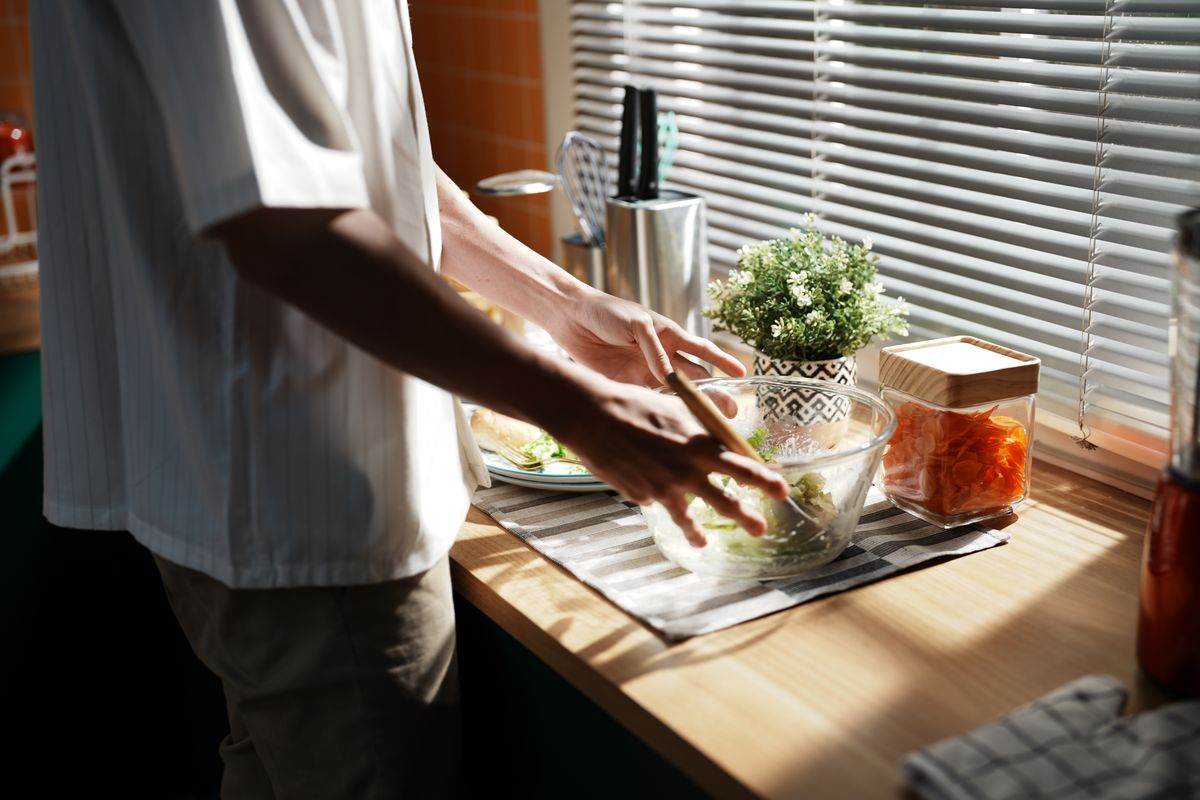
While you are cooking — or waiting for water to boil, or standing in the kitchen deciding what to make — press your palms flat against the counter. Feel the surface. Cool stone. Warm wood. Cold tile. Whatever it is, feel it with your hands and let that sensation land.
This one is quietly powerful for the tight and stuck pattern. When tension lives in your shoulders, jaw, and hands, pressing your palms flat against a solid surface sends a signal through your nervous system: you are grounded. You are here. The counter is not going anywhere. Neither are you.
The Threshold Pause
When you walk through a doorway — any doorway, into any room — take one breath before you enter. Just one. You do not need to close your eyes or make it a moment. Just a breath in the doorway. Three seconds.
Doorways are natural transition points. Your brain already registers them — there is research showing that walking through a doorway can make you forget what you came for, because your mind uses thresholds to close one chapter and open another. The threshold pause works with that architecture instead of against it. You arrive in the next room actually present, not trailing the last room behind you.
If you are someone whose mind races ahead of your body — if you are always in the next thing before you have finished this thing — this one is for you. It is a practice of arriving. And arriving is what the way of wu wei has always been about: being where you are, not where you think you should be.
Phone-Free Walk to the Mailbox
Leave your phone inside. Walk to the mailbox, or around the block, or just to the end of the driveway and back. Two minutes. Five at most. No earbuds. No podcast. Just you and the air and whatever sounds the world is making.
Feel the temperature on your skin. Notice whether there is wind. Look at the sky — actually look at it, the way you did when you were small and had nowhere to be. This micro-ritual is longer than the others, but it is still small. And it is remarkable how foreign it feels to walk somewhere without your phone. That foreignness is the point.
Lighting a Candle at Dusk
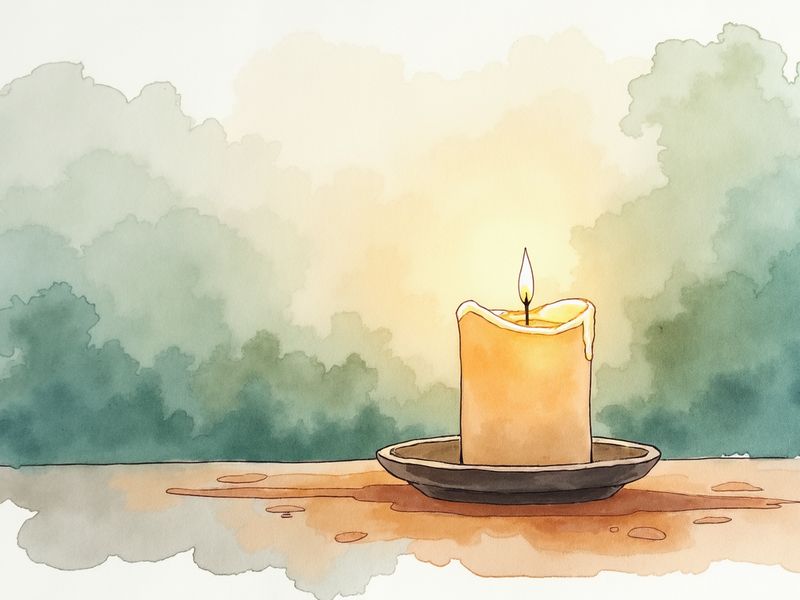
When the day starts shifting toward evening, light a candle. Any candle. It does not need to be special. The act of striking a match and watching the flame catch marks the transition from day to night. Ten seconds.
Every culture in human history has marked this transition somehow. We are the first to ignore it completely — to let fluorescent light flatten the whole day into one undifferentiated stretch. Lighting a candle at dusk is not nostalgia. It is a biological kindness. Your body wants to know that evening has arrived.
The Evening Review
Before you fall asleep, or while you are brushing your teeth, ask yourself one question: what was the most alive moment today? Not the most productive. Not the most impressive. The most alive. The moment when you were most present, most yourself, most here.
Do not write it down. Do not analyze it. Just remember it. Let it play behind your eyes for thirty seconds. Then let it go.
This practice does something quiet and powerful over time. It trains your brain to notice aliveness during the day, because it knows it will be asked about it later. After a week or two, you start catching those moments as they happen. That is not a small thing.

Warm Water First Thing
Before coffee. Before your phone. Before anything. A cup of warm water. Not hot, not cold. Warm. Drink it slowly enough to feel it land in your stomach.
This one is especially good for the cold and depleted pattern — if you wake up sluggish, if your digestion is slow, if mornings feel like you are dragging yourself out of deep water. Warm water first thing is one of the oldest pieces of advice in Chinese medicine. It wakes the digestive fire gently, the way you would coax a coal back to life rather than dousing it with lighter fluid. Your body and breath know the difference.
Dishwashing Meditation
Warm water. Repetitive motion. One dish, then another, then another. Let the dishes be the thing you are doing. Not the thing you are doing while you listen to a podcast, or while you rehash the conversation you had at dinner, or while you plan tomorrow.
Just dishes. The weight of the plate. The slip of soap. The sound of water. The warmth on your hands.
This is particularly settling for the hot and restless pattern, who need repetitive physical tasks to ground scattered energy, and for the tight and stuck pattern, who need their hands to be busy with something gentle. It sounds too simple to matter. It is not.
How to Choose Your Ritual
Here is the rule: pick the one that sounds least like homework.
Not the one that sounds most impressive. Not the one you think you should do. The one that sounds easy. Almost too easy. The one where you think, "That barely counts." That is the one.
Then habit-stack it. Attach it to something you already do every day. You already make coffee — so the first sip ritual lives there. You already eat meals — so three breaths before eating lives there. You already walk through doorways — so the threshold pause lives there. You are not adding anything to your day. You are adding attention to something already in your day.
Try it for seven days before you decide whether it works. Not because seven days is a magic number, but because the first three days will feel awkward and performative, and you need to get past that. By day five or six, if the ritual fits, you will start feeling the pause before you consciously create it. Your body will learn the cue. That is when it stops being an experiment and starts being yours.
If choosing based on your body type sounds helpful, there is a guide for that. But honestly, your instinct is probably right. The one that appealed to you first is the one to start with.
Why One Is Enough
There is a temptation to collect rituals the way you collect apps. Download seven. Use none. The accumulation feels like progress, but it is just another kind of consumption.
One micro-ritual, done with real attention, is worth more than ten done on autopilot. This is not a productivity system. There is no streak to maintain, no level to unlock. There is just you, showing up for thirty seconds of your own life. That is the whole practice.
The Taoist principle here is one of the oldest: less is more. Not as a minimalist aesthetic, but as a description of how reality works. A single point of genuine attention creates more change than a dozen forced habits. Simplicity is not a sacrifice. It is a strategy.
If one ritual works — if it becomes part of your day without effort — another will come naturally. You will find yourself pausing at the doorway without deciding to. You will light the candle without thinking about it. The rituals will find you, the same way cooking slowly becomes natural once you stop treating the kitchen as a race.
But that only happens if you start with one. And only one.
Qi flows best in rhythm. Regular meals, regular sleep, regular moments of conscious attention woven through the hours. In Traditional Chinese Medicine, disease often begins not with a dramatic event but with a loss of rhythm — skipped meals, erratic sleep, long stretches of unconscious doing without a single pause. Micro-rituals function like acupuncture for your schedule: small interventions placed at key transition points that keep everything flowing. An acupuncturist does not restructure your body. She places a needle at a precise point and lets the body remember what it already knows how to do. A micro-ritual works the same way. Thirty seconds at the right moment reminds your qi to circulate, your breath to deepen, your nervous system to settle. The ritual is the needle. Your attention is what makes it work.
You do not need more things to do. You have plenty. You need more moments where you are actually present for the things you are already doing.
Pick one ritual. The one that sounded easiest. Do it tomorrow. Do it the next day. Do not track it, do not optimize it, do not turn it into a project. Just do it, and be there when you do.
Thirty seconds. One transition point. Your whole body, right here.
That is enough. That has always been enough.
If you want to understand why rituals work the way they do, that door is open. If you want to explore rituals beyond tea, that door is open too. But you do not need to walk through either one to start. You just need a cup, a doorway, or a sink full of dishes. You already have everything you need.
And if none of this resonates with the Tea and Ritual path, that is fine. Explore Conscious Living instead. The doors all lead to the same place.