Everyone you went to college with owns a house. Your younger cousin just got promoted. The woman you follow on Instagram has three kids, a business, and visible abs. And you're sitting here at 10 p.m. on a Wednesday, wondering where you went wrong — what turn you missed, what year you wasted.
You've done the math. You've counted the gap between where you are and where you think you should be. And the number is devastating.
But here's the thing nobody tells you: the race you think you're losing doesn't exist. There is no timeline. There is no finish line. You are not behind.
The Invented Race
The feeling of being behind requires a track. A clear, measurable path from Point A to Point B, with everyone running in the same direction. And for most of human history, that track didn't exist — not in the way we experience it now.
It used to be that you compared yourself to the people in your village. Maybe twenty, thirty people in your rough age range. Now you compare yourself to thousands. Social media hands you a scrolling highlight reel of everyone who appears to be further along, and your brain treats it as evidence.
By 25, you should own property. By 30, you should be married. By 35, you should have it figured out. These milestones aren't natural law — they're cultural inventions. They shift by decade, by country, by economic class. They are stories dressed up as schedules.
The Taoist view is simpler. Nature doesn't have a schedule. Spring doesn't panic because winter ran long. Water doesn't rush because the ocean is waiting. Everything arrives when the conditions are right — not when the calendar says so.
This is part of what the ancient Chinese called wu wei — effortless action, moving with the current instead of thrashing against it. It doesn't mean giving up. It means trusting that your unfolding has its own intelligence.
What You're Comparing Against
Let's talk about the person who makes you feel the most behind. The one whose life seems impossibly polished. The one who posts the promotions, the vacations, the Sunday morning routines that look like a magazine spread.
You are comparing your full, unedited life to their curated performance. You're comparing your behind-the-scenes to their trailer.
This isn't a small distortion. It's a complete inversion of reality. You know your own doubts, your sleepless nights, your savings account balance. You know none of theirs. And so you build a story: they are winning, and you are losing.
The person who "has it together" is often the one falling apart in private. The couple with the perfect photos is fighting in the car on the way home. The friend with the dream job cries in the bathroom at lunch. You already know this. You've seen it happen. But when you're scrolling at midnight, you forget.
The Tao Te Ching warned about this thousands of years ago: "The more you look, the less you see." The performance of success is not success. The appearance of a good life is not a good life. And measuring yourself against an illusion will always leave you short. If this hits close to home, you might also recognize yourself in everyone looks like they have it together — because the problem isn't you. It's the lens.
For a deeper look at how constant digital comparison warps our sense of self, read what a Taoist would say about social media.
Natural Timing
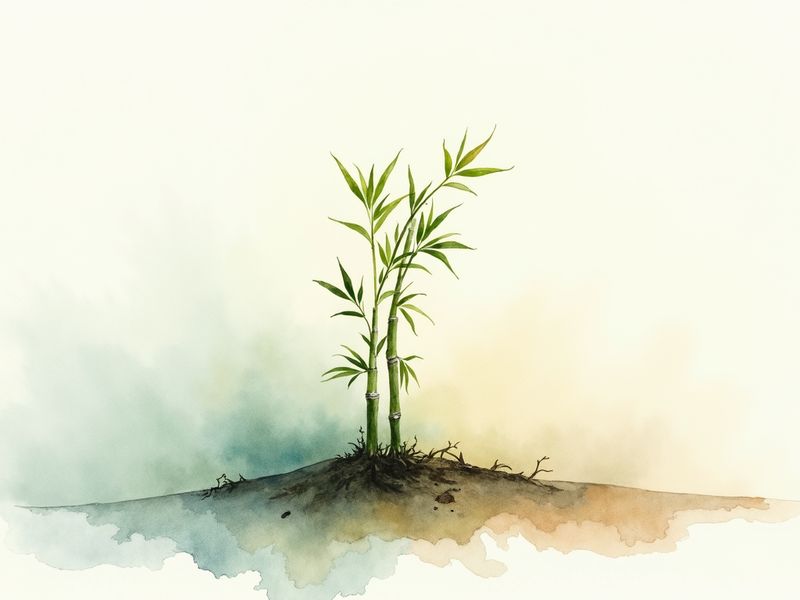
There's a bamboo species in China that spends its first four years doing almost nothing visible. Underground, it builds a root system — quietly, slowly, with no outward sign of progress. Then, in its fifth year, it grows ninety feet in six weeks.
If you checked on that bamboo at year three, you'd think it was failing. You'd think it was behind. You wouldn't see the roots.
Trees bloom at different times. Some fruit takes years to ripen. A peony and a plum blossom share the same garden but answer to different clocks. Neither is late. Neither is early. They're simply on their own rhythm.
Your life works the same way. Your career, your relationships, your sense of self — they each have their own season. Some people find their calling at 22. Others find it at 45. Some marriages happen at 28. Some happen at 60. Some never happen, and the person is whole anyway.
Late bloomers aren't late. That word only makes sense if everyone is supposed to bloom on the same day. They're not. You're not.
This is what Seasonal Living is really about — not just eating with the seasons, but recognizing that your whole life moves in cycles. There are winters. There are dormant stretches. They don't mean you've stalled. They mean something is building that you can't see yet.
What You Can Do Right Now
This isn't the part where I tell you to meditate or journal or recite affirmations in the mirror. The feeling of being behind is sharp and specific, so the response should be too.
Unfollow one account that consistently makes you feel behind. Just one. Not in anger — in self-respect. You don't owe your attention to anyone whose life makes yours feel small. This is not petty. It's practical.
Name one thing you have right now that your younger self would have been grateful for. Not the biggest thing. Not the most impressive thing. Just one real thing. A bed that's yours. A friend who actually knows you. The ability to buy groceries without doing math in the aisle. Your younger self would have taken that deal in a heartbeat.
Stop using other people's timelines as evidence against your own life. Their path is not your measuring stick. Their speed is not your failure. You do not owe anyone an explanation for where you are.
The next time the thought I should be further along by now crosses your mind, ask yourself: according to whom? Whose timeline is this? Because it's probably not yours.
Tight & Stuck: The person measuring themselves against an imaginary standard. You've turned someone else's highlight reel into your report card, and the grade is never high enough.
Hot & Restless: The person burning out trying to catch up. You're sprinting toward a finish line that someone else drew — and it keeps moving.
If you're Cold & Depleted and genuinely struggling with motivation, this isn't permission to stop trying. It's permission to stop comparing.
The River Doesn't Rush
There's a line I come back to when the comparison spiral starts: The river doesn't rush to the sea. It bends. It slows. It pools. And it arrives.
Your life is not a race. It is a river. It has its own pace, its own path, its own way of getting where it needs to go. Some stretches are fast. Some are still. Neither is wrong.
You are not behind. You are where you are. And that is the only place you were ever supposed to be.